MCP: a common interface for model tools and context
Model Context Protocol (MCP) connects AI applications to programs that expose tools and context. It standardizes discovery and communication so an application can connect to compatible integrations without inventing a new interface for each one.
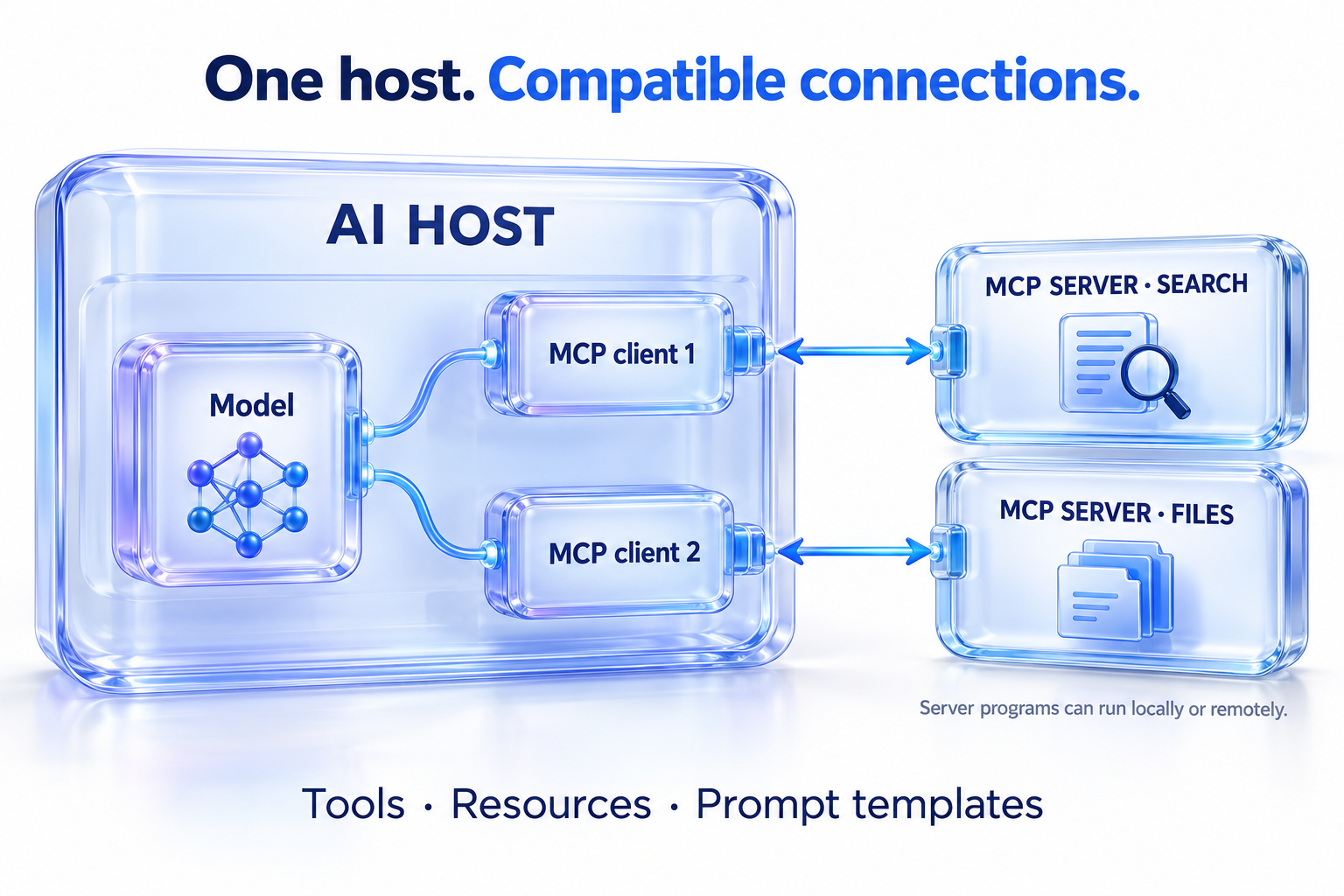
The host is the AI application. A client inside that host maintains a connection to an MCP server. The server is the integration program; it may run on the same machine or remotely. “Server” describes its role rather than requiring a separate cloud VM.
Discover, request, return
A server can list tools with names, descriptions and input schemas. The host can make those capabilities available to its model. When a tool is selected, the client sends a call, the server performs the operation, and a result returns to the host.
For example, a documentation server can expose a search tool. The model proposes a query, the integration runs the search and the returned passages become available to the next model turn. The underlying search implementation remains the server's responsibility.
Tools are only one kind of context
MCP also defines resources, identified by URIs, and reusable prompt templates. A resource can be a file or database schema that the host chooses to include. A prompt template supplies a reusable interaction pattern.
MCP does not train the model, enlarge its context window or determine whether an action is permitted. The host still controls how integrations are exposed and what results enter the conversation.
Tool calling is the model-facing request mechanism. MCP supplies a standardized connection around tools and other context. An agent can use that connection as part of a longer task.